Waiting for the muse

Words to describe me: mom, wife, friend, counselor, household manager, volunteer, health nut, writer. Notice where writer falls on the list. As something that brings me joy but also a fair amount of heartache, it easily slips to the bottom of who I decide to be each day. And when I do carve out time for writing, it’s often in small, interrupted patches, and the muse doesn’t always show up. (Translation: one hour dedicated to writing = 45 minutes on the web/social media/my phone/not writing + 15 minutes staring at a blinking cursor/not writing.)

I know what they say. Get your butt in the chair and put the time in if you want to make something of yourself as a creative person. So I convinced the family to turn our guest room into a writing office. Bought a new desk. Surrounded myself with inspirational things and books and lots of sticky notes. My job is only three days a week, which means I have two whole days to write while the kids are at school. All of the ingredients needed to crank out some amazing stuff.

Reality: See that list above? I volunteer at my son’s school several times a month and serve as committee chair for our local scout pack. I use one of the free days to grocery shop/meal prep/clean. I procrastinate under the guise of keeping up my social media presence. (Translation: waste time worrying whether or not people I’ll never meet will like my mildly witty tweet.)

When I do get my butt in the chair at my beautiful desk that is often covered with all things not related to writing, I worry. Worry about my stories and whether or not they will ever sell. Worry about the words coming out of my brain, especially when they seem stuck somewhere between there and my fingertips. Worry about all of the other things I should be doing, like cleaning out the basement or snuggling with the cat.

I recently read that you should carve out the same place/time each day and your muse will show up because he/she/they will know where to find you. Makes sense. John Cleese has a great video about how we need to allow ourselves time to get into the creative space in our mind, which for the modern writer may mean browse social media, search for the perfect playlist, make/purchase a comforting mug of your favorite warm beverage. The thing is, life doesn’t always allow for the same place/time for writing, and we use distractions as an excuse of settling in instead of truly settling in.

Take last Wednesday for example: It is my day off from work. Writing day. YAY! But the previous Friday was a snow day, so I had to go into work to make up the missing hours. It’s also usually the night I meet up with my writing group, but my older son has started indoor soccer practice at an elementary school on Wednesday nights with no place to sit and work. I decide to bring my laptop and find someplace nearby to write.

6:55 Drop son off at practice. Drive to nearby store with café.
7:00 Scope out the space and wait for barista to finish previous person’s order.
7:05: Order a cup of tea, decide on a small dessert, chat with barista.
7:10 Fire up computer, log into wifi, check twitter, tweet about how warm it is.
7:20 Log into library site, look for music to stream.
7:25 Open document, read last few pages, stare into space trying to decide what to write next.
7:35 Start writing.
7:50 Realize we need milk at home and if I want to buy some and get back to pick up son by 8:00 I need to wrap things up.

Fifteen minutes of writing. I wrote about 300 words. That’s the problem. Sometimes it takes so long to get all the other crap out of the way that when I actually start to feel the muse show up, it’s time to stop. At home, this may mean someone/thing requires my attention, or I wasted five and a half hours doing other things and now it’s almost time to get my son from school. Don’t get me wrong, I’ve managed to make it work at other times, like when the boys practice at the athletic center that not only has no wifi, but there’s a dead zone so even data on my phone doesn’t work. Just one hour of no distractions—buckle down and get some words on the page already—writing time.

Every writer I know has a list of other things that require their attention and responsibility. And often making the choice to write means you are sacrificing something else. Made worse by the fact that you may sit there, missing whatever it is you’ve chosen not to do, and stare at the screen. Waiting.

Don’t give up on your muse. Do what you need to do to get into the zone, even if that leaves only a handful of minutes for writing. I beat myself up the other night about only getting 300 words down, but hey, that’s 300 more than I had when the night started. And now I know the routine of that particular place and can change my approach next time.

I daydream about the possibility of giant chunks of uninterrupted writing time, just me and my muse, hanging out, telling stories. But reality can be cruel, and it forces me to figure out how to make it work when I can if I want to bump writer up the list. I do. Because, heartaches aside, it feels good to be in the zone. There’s really nothing else quite like it.

Cheerleader for a month

Back in December, I decided to help out an online writing community by volunteering to be the January hashtag leader. Let me back up. Sometime last year I discovered the monthly writing challenge on Twitter; each day you try to write at least 500 words or edit for an hour, then enter your stats on a shared spreadsheet. The next day, whoever is the monthly hashtag leader will shout out the handles of anyone who completed the challenge. The recognition is highly motivating, and it’s a pretty awesome feeling if you make it through the whole month. I’ve only done it once. But I pop in now and then, post my word count on the hashtag, and chat with other writers. It is a wonderful, supportive community.

So when I saw an open space for January’s leader, I jumped at the chance to give back. Every morning for 31 days I checked the spreadsheet and did a shout out on Twitter. It was fun looking for new and interesting GIFs, and read/see other’s responses. And my phone ping-pinged ALL DAY, which made me feel incredibly popular. I interacted with other writers on the hashtag by liking their post and/or giving them words of encouragement (often in the form of a GIF – I used to hate those things but have grown to love them). I made a bunch of new virtual friends. On the last day we began comparing the weather in our respective corners of the world and brainstormed how we could get together for a celebration.

It’s the third day of February, and my phone is freakishly silent. The challenge continues every month, but there is another writer at the helm, doing daily shout outs and offering kindness. But I want to keep the feeling going. I want to be the person who makes others feel good. That’s never really been my M.O. I’m more of a pessimist than a cheerleader, but that life tends to be awfully lonely. Most days I’m okay with that. Leave me alone to my book/laptop/cup of tea/snuggly cat, and I’m perfectly content. Writing is a solitary thing, and my mind needs that space to work creatively. But we also need each other. We need people to cheer us on, to talk us off a ledge when we freak out about querying or edits, to keep us moving forward when we feel like our wheels are stuck in the mud.

I saw a post the other day about how difficult it is to “jump into” the various writing groups online. One of the responses compared it to looking for a place to sit in the cafeteria and being afraid to approach a table full of strangers. I get that. When I first got on Twitter I didn’t quite get it; it felt like I was peering over someone’s shoulder at their string of text messages. Eventually I stumbled upon the write club hashtag, and started to build my online community. We sprinted every Friday and it was during one of those sprints that I finished my first book. There are a ton of great writing hashtags to follow, and there really is no secret to belonging. You jump in, either with your own stuff or an encouraging phrase or GIF directed at someone else, and go from there.

It’s a heck of a lot easier than talking to strangers at a party. In my opinion anyway.

Turn into the skid

Writing is a lot like driving in the snow.

It takes a fair amount of practice before you are able to confidently keep yourself from careening into a snowbank. You need to stay focused, proceed slowly and with caution. Be mindful of others on the road, but don’t get too close – in other words, pay more attention to your own vehicle rather than worrying about what everyone else is doing. And mostly, be prepared for the skid. That moment when you feel a loss of control, your tires are desperate for traction, and slamming on the brakes will only make it worse. When your instinct tells you to turn the wheel in the opposite direction because that will keep you on the straight and narrow.

But anyone who has ever driven in snow knows: when you start to lose control, take your foot off the gas and turn into the skid. Don’t ask me to explain the physics, just trust me on this one. I learned to drive in Buffalo. We know snow. And I’ve had my fair share of HOLY CRAP moments when the car does the opposite of what you want it to. My first vehicle was a rear-wheel drive that I nicknamed The Boat. That bad boy fishtailed like nobody’s business. And once, in my little Civic, I made a left hand turn that kept going until I faced in the complete opposite direction of where I had intended to go.

Writing has its share of skids. You’re cruising along, slowly and carefully. Then you send your story/novel/query letter to a beta reader, or if you are feeling especially brave – an agent or editor. Then feedback comes and suddenly you feel yourself careening off the road. You want to slam on the brakes. Give in and slide right off the road and into the shoulder. Or try to crank the wheel in the opposite direction, saying forget it – I’ll never make it as a writer.

Don’t. Ride the skid. Turn into it. Let yourself be out of control for a moment or two. Maybe you’ll end up in the snowbank anyway. It happens. That’s why you carry a shovel in your car, extra blankets, and a bottle of water. After the feedback, you may need to dig yourself out. That’s okay. The important thing is to get back on the road. Cry a little first. Eat some chocolate. Pet the cat. Call a friend.

You are the driver on this journey. You can’t control the weather, you can’t control what other idiots are on the road trying to keep you from getting to your destination. But you are the one behind the wheel. You know when to put your foot on the gas, when to apply the brake, and when to let go of everything and turn into the skid.

How’s your book coming?

Ah, the ever present question in writing circles: How’s the current project coming along? Whether you’re working on an initial draft or revision number (enter ridiculous number here – in my case anyway), fellow writers and basically anyone to whom you’ve mentioned that you’re working on a book want to know how things are going. And that’s great. It helps keep the motivation up when it may be dragging, and can be a supportive part of an often desolate journey.

But when things aren’t going well, it’s a question that makes me want to bury my head in the sand. Or, as my son often does when he gets home from school, turn my thumb sideways and then point it down. Although truth be told, he often turns it back to sideways or up; he’s like the scales on a diet show – was it a good day or bad day? Stay tuned to find out!

Can you tell I’m avoiding the question? Really though, how is the current project going? It’s experiencing long periods of drought with the occasional burst of creative genius, followed abruptly by bouts of frustration and/or hours of staring into space, willing a solution to magically appear out of my fingertips.

Here’s the problem. My book tells two stories. One is mostly true (based on my grandmother’s memoirs) until it becomes completely not true. The other is not true, but loosely based on a real event. I had a million ideas and took this giant bowl, poured them all in, and hoped for the best. Then I spent many, many hours rearranging post-it notes that have long ago lost their stickiness and revising until the two stories more or less came together. They came together, I’m just not entirely happy with things yet. So, following some helpful feedback from my amazing critique group, I went in with a knife and sliced the poor thing up some more.

I have a tendency to start projects and not finish them. It’s kinda my M.O. Back when a popular drink was putting six word memoirs on the inside of its caps, one of my teacher friends decided to do that as a class activity: Write a six word memoir. And could I please write a sample for her to use? Hubs was quick to offer up this one: HAS BIG IDEAS, NO FOLLOW THROUGH

Yup. I’m working really, really hard at changing that, says the girl who stalled on revisions all summer. And I try not to dump the contents of some cabinet or other onto the floor and then decide partway through that I don’t feel like sorting through all of it. I mean, I totally packed up that box of memories after I… only… went… through… half. Crap.

Back to the WIP. When I see my writer friends, especially ones who have read through the story, they say encouraging things like how they thought it was good and that I should query the darn thing already. But then I have moments where I worry that I am not honoring my grandmother’s memory properly and maybe I shouldn’t fictionalize the second half of her life, but honestly she went on to have kids and they had kids and she baked a lot of cookies and pies and they were delicious. Not quite the page turner I’m hoping for.

So where do I go from here? Well, I ignore the curled up, note covered pages of the manuscript on my desk, the notebooks and scraps of paper with random ideas piled on top, the now neatly arranged sticky notes on the back table (after they spent several weeks on the floor, getting occasionally slept on by the cat), and this:

memoirs

A copy of Grandma’s memoirs, the ones she was working on when she died, edited and bound by yours truly in the days leading up to her funeral so that I could pass out copies to everyone in the family. And do you know what I found last month while cleaning out the basement? An original copy of the first section, with a note to me, date November 17, 2001 – right before Buffalo got hit with a terrible snow storm (I was living in South Carolina at the time – Grandma mentions that bad weather was predicted). A note that explains how excited she is to be writing down the story of her life.

And then there’s this:

grandma

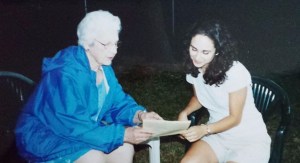
That’s me and Grandma, in July 2001, looking over some pages while visiting her cottage. She counted on me to help her with the writing, to teach her how to use word processing. And even though she’s gone, I know she’s counting on me to get this right. But the problem is, I don’t know exactly what that means.

So I stall. Procrastinate. Work on other things. This story is my heart, and maybe part of it is that I don’t want to face the inevitable rejection that comes with querying, but it’s mostly that I am afraid of getting it wrong. Of somehow hurting her memory.

Now you know why, if you ask me how writing is going, I get a faraway look in my eye that is a mix of frustration, determination, and sadness. My grandmother was amazing, and however the story turns out, I want to make her proud.