How to pack for Camp

Camp NaNoWriMo starts Monday which, incidentally, is also the day I become a parent of a teenager.

I can’t decide if I should be stocking up on coffee or vodka.

This April marks my fourth time doing Camp NaNoWriMo, which is a relaxed version of the National Novel Writing Month that takes place every November. You set your own writing goals, and I learned the hard way that they better be realistic or I’m a barrel of disappointment by the time I reach the end of the month.

Writing camp takes preparation, much like regular camping. The first time I tried it, I was woefully unprepared. It was a disaster, much like the first time hubs and I went camping and realized we were missing about half the things one needs to survive a weekend in the woods.

My life is a bit crazy. But recently I decided that if I am going to be a successful writer, I need to look at it more like a second job rather than a hobby. Something I commit to. Solid, productive writing. Not opening a word document, staring at it for a while, then wandering the Internet. The problem? I’ve been frustrated with my current project and afraid to wander back into the novel I shelved last year after a round of query rejections. I needed to get out of my head and let the words flow. But how?

While writing SECOND IN COMMAND, I had tight deadlines, which was extremely motivating. So the first thing I did was look at my calendar and give myself an end date. The annual PennWriters conference is mid-May, and I signed up for pitch appointments. Which means I need to have a project to pitch. A finished project.

Step One: Set a deadline for writing project. Commit to focusing on that project ONLY.

I printed out a March-April calendar, looked at it alongside our life calendar, and circled days I would be able to write. I think one of the obstacles facing writers who also work, raise children, take care of households, etc, is that we feel guilty carving out time for writing. But writing is important. Even if it pays very little or not at all, it is something I need to have in my life. I’m happier when I’m writing. It’s therapy. So far I have followed through and written on my circled days, and on the non circled days I spend extra time with my family or just relax. Giving myself permission to take time off in between has helped me focus on my writing days.

Step Two: Create mini-deadlines. Make them reasonable. If they aren’t working, revisit the schedule. Celebrate success. Crossing off days is weirdly rewarding. (Stickers work well too.) I calculated how much work I need to do to finish the project in time for PennWriters, and wrote mini-deadlines on the circled days.

The time part figured out, I moved to the other part of my blockage. Where the hell do I even start with this thing? The novel originally had two separate story lines, and the feedback I got was that they weren’t gelling and a few agents didn’t like the one character’s voice. So I cut her. And was left with half a book. Now what? I needed to get back to the drawing board. I read books on outlining and plotting, and thought ugh, I’m normally a panster, but I don’t have time to spend in multiple revisions. I need to fill the plot holes early.

Step Three: Make a plan. Get the hard stuff out of the way.

I brainstormed on my trusty legal pad, then filled out note cards for each chapter. They’re three different colors to indicate where they fit within the three act structure. I figured out which chapters from the original version would work moving forward and where I’d need to add additional content.

I’ve been writing for two weeks now, and the note cards have been an amazing tool. I know where the scene starts and what I need to include and can focus fleshing out characters and creating tension. The fun stuff. I told hubs last night that this is the first time I’ve been able to write freely in a long time. It feels good. Of course there was a large hurdle to overcome — my first scene is brand new, and right now, it’s not great. But I got to the point where I had to tell myself to let it go and move on. To paraphrase Dory: Just Keep Writing.

Step Four: Find ways to keep the flow moving. Meditate. Close your eyes and focus on your breath. Go for a walk. Focus on how your senses perceive the world around you.

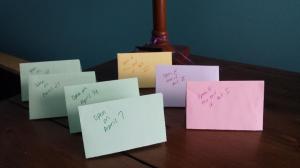
Step Five: Love yourself. The last thing I did to get ready is a tip I learned from @qnwrites on Instagram. She posted about writing a letter to her future self that she’d open during Camp. I loved this idea and expanded it a little by writing letters to my future self to be opened at the end of each week of Camp and when I finished each section of the book.
notes

They’re color coded to match my index cards. Of course.

I taped them up on my bulletin board to keep myself on track and motivated.

April is packed. The boys’ activities fill our calendar, my parents return from Florida mid-month, and our biggest recruitment event at work happens on April 30. In addition to Camp NaNoWriMo, I’m also this month’s hashtag leader for the Writing Challenge  on Twitter. And we’re taking a mini vacation to visit family. Whenever I open my online calendar, panic ensues.

Step Six: Commit to sit. It’s the only way. Fill the coffee mug, crank the tunes, and write.


What’s the worst that could happen?

A common approach to dealing with one’s fears and anxiety is to imagine a worst-case scenario. What is the worst thing that could happen if you do X? For some reason this approach doesn’t seem to work on me as I have already imagined not only the worst-case scenario but also the slightly less troublesome scenarios on a sort of sliding scale. Want to know what I’m worrying about at any given moment? Pull up a chair, I’ll make you a list.

We’ll start with this one: I have a slight car wash phobia. The car wash in Buffalo is not simply a place you go every once in a while to get your car cleaned. It’s a way of life. If you think I’m kidding, stop by a car wash in Buffalo on a sunny day in January-April. Better yet, try to drive down the main road that leads into said car wash. People around here are very serious about salt removal.

And for good reason. My last van rarely saw the inside of the car wash due in large part to my irrational phobia, and it suffered from extreme rust. When we bought the new van, hubs decided I needed to get regular washings. He signed up for the unlimited car wash club because you get to go through the express lane, and he didn’t want to wait three hours every time we came to the car wash. Whenever it needed to be cleaned, which is pretty much every day for the entire season, I politely asked hubs to take my van please and drive it through so I don’t have to. Why, what’s the problem? he asked.

What’s the problem? I’m afraid of the car wash. Obviously.

We’ve known each other for 26 years. He’s used to my laundry list of ridiculous things that send me into a panic. Bees. Parking garages. Ordering food on the telephone. Making any phone call at all for that matter. So he didn’t seem all that phased by my car wash phobia confession. Didn’t tease me about it. Took my van when he could and would make sure he was driving if we went through together. At one point he asked what it is exactly, that makes me nervous?

Me, slightly embarrassed but nevertheless pleased he seemed to be trying to understand my phobia: Everything.

How do I even attempt to explain — it’s the social construct of getting into line and negotiating exactly what needs to be cleaned on my car and how, lining the tires up perfectly on the track and then relinquishing control of the steering wheel, the claustrophobia of the actual car wash, and of course my environmental brain that can’t help but wonder how many gallons of water pump through that place all day. Oh, and then getting out of the parking lot safely and back onto the busy street while a pile up of anxious drivers in clean cars accumulates behind me.

See? Everything.

He made no fuss and continued to take my car in dutifully, until he left for three weeks. And it snowed. A lot. I had to face the demons in my mind and just go through the stupid thing by myself. So I did. After a lot of deep breaths and a quick pep talk on the way in. I even went back a second time with my son, who happens to LOVE the car wash for some strange reason. One of the things that has helped me face my anxiety is having to parent with it. I refuse to allow the panic to win when I’m with my kids. It’s not always easy, believe me, and I got super lucky to adopt two outgoing boys who aren’t afraid to ask for things or stand up for themselves.

But the experience got me thinking. Living with anxiety is a daily struggle, but there are things I can choose to control that will make it easier. For example: when it comes to socializing and making small talk, I’m — oh what’s a nice way to say this — I suck. But I’ve learned through attending conferences and my job as an admissions counselor that it is a skill one needs in life. I’ve been working on it and (hopefully) getting a bit better. Don’t get me wrong, I’ve still gone to parties recently and stood awkwardly by myself staring into my glass or walked away from a conversation thinking, why the hell did I say that?

Baby steps.

I decided to do a bit of a life experiment. When something comes up that makes me anxious, instead of asking myself what’s the worst-case scenario, I ask myself, would you feel better/improve the situation by doing the thing currently making you anxious? The car wash still makes my heart race, but I love seeing my clean vehicle and feel better knowing I’m protecting it against rust damage. There have been times when I felt the fear creep in during a situation — say I was nervous about asking someone for help or directions, or to clarify something, and I asked myself, will the information I need make the situation better? Yes? Then ask.

There are a lot of layers in my psyche full of worst-case scenarios. I already told my oldest that he better get used to checking in as I will regularly be imagining him in a ditch on the side of the road. I can’t alter the fundamentals of my brain. But I can take small steps toward not letting my fears keep me from the good things in life, like a clean car, new friends, or instead of the worst thing — imagining the best thing that could happen.

Launch party love

I feel incredibly blessed. Last night was the launch party for Second in Command. Friends, family, and coworkers came out to help celebrate and many others shared their well wishes throughout the day. I even met a few new people who heard about the event and wanted to check out my book.

I wanted to share my speech here for anyone who missed it because I think so much of writing is about the journeys we take and the people who help us along the way.

Thank you, Gina for that perfect introduction, and a huge thank you to Mary and the Burchfield Penney Art Center for hosting this event. Mary runs a book club here on the first Thursday of every month – it celebrates local Buffalo authors and it’s a wonderful way to learn about the history and culture of Buffalo and be exposed to some of our amazing talent. *(Note: the next book club is March 7)

At the risk of sounding like I’m at the Oscars (if I go too long feel free to cue the obnoxious music), there are a bunch of people I need to thank for getting me up here. My parents, for believing in me and traveling back from Florida into the icy grips of Buffalo to help celebrate and bake cookies. My mother in law, and my sister and her family for their support and encouragement, my kiddos for inspiration – this is the first thing I’ve written they could actually read (usually there’s a tiny bit of swearing in my books). And that handsome man in uniform who endures endless rounds of brainstorming, as well as my fits of jealously and self-doubt and all the other demons we writers face. He’s always there with practical advice like, “Just sit down and write.” As many of you know, he was active duty Navy for five years and now serves as a Reservist. We were apart for most of 2003 and I pulled on some of those memories when writing the book. But more about that in a bit.

I want to thank my friends and family – coworkers, both past and present, scout friends and writer friends – especially my Wednesday night and sometimes Sunday afternoon clan, members of our local children’s writers and illustrators (we’re known as BNCWI), Kristy my cheerleader, Jenn for our writing slash counseling sessions, Dee for introducing me to this crazy world of children’s books, my beta readers – CJ, Claudia, Carla, Gina, and Lilly. Sam, who designed this beautiful cover. Caitie, and everyone at West 44 who took a chance on my idea and helped make a lifelong dream come true. Everyone here today for coming out and supporting me. Thank you, thank you, thank you.

Okay, cue the music. Onto the juicy part. How did I get here? No wait, that’s a Talking Heads song. Here’s the condensed version. When I was 16, I wrote a lot of angsty poetry. Like Leo, the main character in Second in Command, I was trying to figure out who I was and where I fit in the world. That’s the great thing about young adult literature. We can all relate to those feelings of identity and fitting in – they’re universal. And writing, for me, as a far from 16-year-old who still carries a few wounds on her heart, is a form of therapy. You present readers with a character who has a goal, give him/her obstacles, and then here’s the fun part – you help them figure out how to solve their problems. And unlike real life, there are revisions – you can change the course of events and your characters’ reactions, you get to be in control of their fate.

I get the YA part, you say, but what is a verse novel? A verse novel is a story told entirely through poetry. Poetry is beautiful because it strips everything down to raw emotion – much like the teenage experience. When Caitie told our critique group about her new imprint that would feature verse novels for struggling readers I thought, YES! Brilliant! I used to teach high school students with learning disabilities, and I remember how some of them struggled to find accessible literature that spoke to their experiences in a way that didn’t feel dumbed down. Poetry can be intimidating to some, yes, but it can also be freeing in a way because there’s all this white space on the page and the sentences are bare, the emotion is right there for the reader to see and feel.

I was excited to be part of something like that – and to be able to write poetry again. While that might frighten some writers, I immediately started to think about the different types of poems I could use and how I’d be able to play with language and structure. The clincher? One of the possible topics was deployed parents. Poetry, young adult book for struggling readers, about a military family. Around our house we call that the Trifecta.

So I created Leo, and I gave him a goal – he wants to earn Eagle Scout and become a police officer, and I gave him conflicts – Mom, who he admires and depends on to a degree, gets deployed and younger brother Jack quickly takes advantage of the situation by getting into trouble. It’s clear the brothers are close, but they fight – in the way brothers do. Not that I have any experience with that or anything. And Leo feels this strong sense of responsibility, especially when it comes to his siblings, but he’s also freaking out a little. And when I sat down to write I had to dredge up some difficult memories of my husband’s deployment. I wanted the story to be real for my readers. I had to tap into those feelings and remember the other families from that time. It was 2003 and everyone in our little military town knew someone who was deployed. Leo’s family was inspired by our next door neighbors. Mom left with the hospital ship. Dad commuted over an hour to work each day. The kids looked out for each other. It was sweet and heartbreaking, and they stayed with me for a long time.

I pitched my idea, and they liked it. Then came drafting, deadlines, revisions – all that good stuff.

Writing isn’t easy. It’s lonely. Sometimes it feels like I cut up my heart and put it onto the page. And when you’ve got a world of other things on your plate – work, family, volunteering – you squeeze it in whenever and wherever you can. I wrote most of the book on a picnic table inside Epic Sports Center while my kids were at soccer practice. But then there was a book. With my name on it. And that was pretty awesome. The most rewarding thing for me is the opportunity to tell a story people connect to. When someone reads a poem and thinks, yes, this speaks to how I’m feeling. That is really powerful.

There are moments in my life when I felt so, so lonely and I would turn to my journal, or I’d turn to a book and get lost in the story. Words have a weird way of healing. My hope is that you pick up this book and whether you’re part of a military family or you had someone in your life that you depended on and now they’re gone and you’ve gotta figure it out on your own – of if you’ve ever had to decide where your loyalty lies, you’ll pick up this book and you’ll feel a connection to the characters, you’ll feel understood, you’ll feel a little less alone.

author

me, being authorly

Yeah, it was cold, and I’m a little crazy

Friday morning at work, the wind whistling angrily against our office windows, the following conversation took place:
Coworker: What are your weekend plans?
Me: Oh, I’m going camping.
Coworker: …
Me: Yup.
Coworker: It’s supposed to be really cold this weekend. Are you crazy?
Me: (briefly contemplates) Yup.

One fateful day, when oldest was in first grade, I walked past the cub scout recruitment table and asked for more information. I had been a girl scout through high school and thought scouts would be good for our boys. Oldest and I went to the information night, and he was immediately hooked.

Little did I know how that decision would affect my life these past six+ years. Both our boys are active in scouting and oldest hopes to earn the highest rank of Eagle. Many of our close friends are fellow scout parents, and scouting has seeped into my life in more ways than I could have imagined.

Writing, for example. Leo, the main character in SECOND IN COMMAND, is working toward Eagle and strives to live his life by the scout law. In my current WIP, the main character paved the way for girls in BSA (the new name for Boy Scouts of America as girls are now welcomed at all levels). Side note, I am all for an integrated scouting program – we are one of the only countries who segregate by gender. Personally I think we should merge the good things about girl scouts and boy scouts and create one unit, let’s call it something simple like, Scouts of America (why are they leaving the “B” in there I wonder?), and allow anyone to join.

Scouting has also pushed me out of my comfort zone on multiple occasions. Sometimes to an unpleasant end, like the time I rowed into the swimming dock. And sometimes to an uncomfortable end, like this past weekend when we camped in single digit temperatures (minus 20 with the wind chill). But I’ve learned in my wise old age that trying something you didn’t think you could do introduces you to some amazing experiences. A good friend tried Aerial fitness a few years back and is completely hooked — we tease her that she joined the circus, but the stuff she does is incredible.

When oldest started going on camp outs with scouts, hubby would take him. They would have fun and come back filthy, the clothes I packed still neatly folded in their bags. I’m pretty sure the kids stayed up until 2am and ate an obscene amount of cheese puffs on those trips. Then youngest joined the pack, and I decided to go on camp outs too, partly because I wanted to have an extra set of hands/eyes on our kiddos, and partly because I didn’t want to be left out. I love camping and nature. I don’t mind outdoor bathrooms (although I will say after this weekend that you haven’t truly lived until you’ve experienced sub zero winds under the doors of a latrine) or getting dirty and going without makeup, running water, etc.

Problem: I didn’t exactly want to be the only mom there. The party crasher who makes her kids brush their teeth, go to bed before midnight, and change their underwear. Thankfully one of the other moms joined me on my first camp out, and we’ve gone together to almost all of them since. And now there are lots of moms who come out, and they bring disinfecting wipes for the latrine and healthy snacks, and I love that we watch out for each other. Some of them have become my closest friends.

camp moms

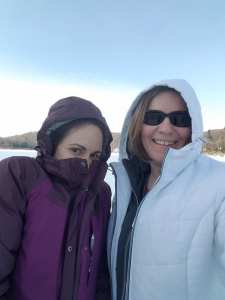
Camp moms are hardcore*

Just as scouting has opened up new ideas and opportunities for my boys, it has given me the chance to connect to nature, to other people, and to my own strengths. I joined the committee and developed my leadership skills. I’ve learned how to deal with challenging situations. I’ve been able to perform for an audience (my rendition of “Have you ever seen a penguin drinking tea” is killer) which fuels the attention seeking side of my introverted personality.

I guess my point is this: you never know when an opportunity is going to change the course of your life. Stay open to new things. I volunteered to co-lead an activity at my son’s school and met my very first writer friend. She led me into a world of other writers which eventually led to the opportunity to write SECOND IN COMMAND. Sometimes when something new comes our way our first instinct is to say no, our plate is full enough already, thank you. But the thing you are eager to say no to might just be the thing that changes your life for the better.

*It was 4 degrees out when we took this picture.