How to pack for Camp

Camp NaNoWriMo starts Monday which, incidentally, is also the day I become a parent of a teenager.

I can’t decide if I should be stocking up on coffee or vodka.

This April marks my fourth time doing Camp NaNoWriMo, which is a relaxed version of the National Novel Writing Month that takes place every November. You set your own writing goals, and I learned the hard way that they better be realistic or I’m a barrel of disappointment by the time I reach the end of the month.

Writing camp takes preparation, much like regular camping. The first time I tried it, I was woefully unprepared. It was a disaster, much like the first time hubs and I went camping and realized we were missing about half the things one needs to survive a weekend in the woods.

My life is a bit crazy. But recently I decided that if I am going to be a successful writer, I need to look at it more like a second job rather than a hobby. Something I commit to. Solid, productive writing. Not opening a word document, staring at it for a while, then wandering the Internet. The problem? I’ve been frustrated with my current project and afraid to wander back into the novel I shelved last year after a round of query rejections. I needed to get out of my head and let the words flow. But how?

While writing SECOND IN COMMAND, I had tight deadlines, which was extremely motivating. So the first thing I did was look at my calendar and give myself an end date. The annual PennWriters conference is mid-May, and I signed up for pitch appointments. Which means I need to have a project to pitch. A finished project.

Step One: Set a deadline for writing project. Commit to focusing on that project ONLY.

I printed out a March-April calendar, looked at it alongside our life calendar, and circled days I would be able to write. I think one of the obstacles facing writers who also work, raise children, take care of households, etc, is that we feel guilty carving out time for writing. But writing is important. Even if it pays very little or not at all, it is something I need to have in my life. I’m happier when I’m writing. It’s therapy. So far I have followed through and written on my circled days, and on the non circled days I spend extra time with my family or just relax. Giving myself permission to take time off in between has helped me focus on my writing days.

Step Two: Create mini-deadlines. Make them reasonable. If they aren’t working, revisit the schedule. Celebrate success. Crossing off days is weirdly rewarding. (Stickers work well too.) I calculated how much work I need to do to finish the project in time for PennWriters, and wrote mini-deadlines on the circled days.

The time part figured out, I moved to the other part of my blockage. Where the hell do I even start with this thing? The novel originally had two separate story lines, and the feedback I got was that they weren’t gelling and a few agents didn’t like the one character’s voice. So I cut her. And was left with half a book. Now what? I needed to get back to the drawing board. I read books on outlining and plotting, and thought ugh, I’m normally a panster, but I don’t have time to spend in multiple revisions. I need to fill the plot holes early.

Step Three: Make a plan. Get the hard stuff out of the way.

I brainstormed on my trusty legal pad, then filled out note cards for each chapter. They’re three different colors to indicate where they fit within the three act structure. I figured out which chapters from the original version would work moving forward and where I’d need to add additional content.

I’ve been writing for two weeks now, and the note cards have been an amazing tool. I know where the scene starts and what I need to include and can focus fleshing out characters and creating tension. The fun stuff. I told hubs last night that this is the first time I’ve been able to write freely in a long time. It feels good. Of course there was a large hurdle to overcome — my first scene is brand new, and right now, it’s not great. But I got to the point where I had to tell myself to let it go and move on. To paraphrase Dory: Just Keep Writing.

Step Four: Find ways to keep the flow moving. Meditate. Close your eyes and focus on your breath. Go for a walk. Focus on how your senses perceive the world around you.

Step Five: Love yourself. The last thing I did to get ready is a tip I learned from @qnwrites on Instagram. She posted about writing a letter to her future self that she’d open during Camp. I loved this idea and expanded it a little by writing letters to my future self to be opened at the end of each week of Camp and when I finished each section of the book.
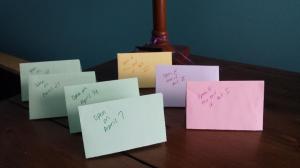
notes

They’re color coded to match my index cards. Of course.

I taped them up on my bulletin board to keep myself on track and motivated.

April is packed. The boys’ activities fill our calendar, my parents return from Florida mid-month, and our biggest recruitment event at work happens on April 30. In addition to Camp NaNoWriMo, I’m also this month’s hashtag leader for the Writing Challenge  on Twitter. And we’re taking a mini vacation to visit family. Whenever I open my online calendar, panic ensues.

Step Six: Commit to sit. It’s the only way. Fill the coffee mug, crank the tunes, and write.


Launch party love

I feel incredibly blessed. Last night was the launch party for Second in Command. Friends, family, and coworkers came out to help celebrate and many others shared their well wishes throughout the day. I even met a few new people who heard about the event and wanted to check out my book.

I wanted to share my speech here for anyone who missed it because I think so much of writing is about the journeys we take and the people who help us along the way.

Thank you, Gina for that perfect introduction, and a huge thank you to Mary and the Burchfield Penney Art Center for hosting this event. Mary runs a book club here on the first Thursday of every month – it celebrates local Buffalo authors and it’s a wonderful way to learn about the history and culture of Buffalo and be exposed to some of our amazing talent. *(Note: the next book club is March 7)

At the risk of sounding like I’m at the Oscars (if I go too long feel free to cue the obnoxious music), there are a bunch of people I need to thank for getting me up here. My parents, for believing in me and traveling back from Florida into the icy grips of Buffalo to help celebrate and bake cookies. My mother in law, and my sister and her family for their support and encouragement, my kiddos for inspiration – this is the first thing I’ve written they could actually read (usually there’s a tiny bit of swearing in my books). And that handsome man in uniform who endures endless rounds of brainstorming, as well as my fits of jealously and self-doubt and all the other demons we writers face. He’s always there with practical advice like, “Just sit down and write.” As many of you know, he was active duty Navy for five years and now serves as a Reservist. We were apart for most of 2003 and I pulled on some of those memories when writing the book. But more about that in a bit.

I want to thank my friends and family – coworkers, both past and present, scout friends and writer friends – especially my Wednesday night and sometimes Sunday afternoon clan, members of our local children’s writers and illustrators (we’re known as BNCWI), Kristy my cheerleader, Jenn for our writing slash counseling sessions, Dee for introducing me to this crazy world of children’s books, my beta readers – CJ, Claudia, Carla, Gina, and Lilly. Sam, who designed this beautiful cover. Caitie, and everyone at West 44 who took a chance on my idea and helped make a lifelong dream come true. Everyone here today for coming out and supporting me. Thank you, thank you, thank you.

Okay, cue the music. Onto the juicy part. How did I get here? No wait, that’s a Talking Heads song. Here’s the condensed version. When I was 16, I wrote a lot of angsty poetry. Like Leo, the main character in Second in Command, I was trying to figure out who I was and where I fit in the world. That’s the great thing about young adult literature. We can all relate to those feelings of identity and fitting in – they’re universal. And writing, for me, as a far from 16-year-old who still carries a few wounds on her heart, is a form of therapy. You present readers with a character who has a goal, give him/her obstacles, and then here’s the fun part – you help them figure out how to solve their problems. And unlike real life, there are revisions – you can change the course of events and your characters’ reactions, you get to be in control of their fate.

I get the YA part, you say, but what is a verse novel? A verse novel is a story told entirely through poetry. Poetry is beautiful because it strips everything down to raw emotion – much like the teenage experience. When Caitie told our critique group about her new imprint that would feature verse novels for struggling readers I thought, YES! Brilliant! I used to teach high school students with learning disabilities, and I remember how some of them struggled to find accessible literature that spoke to their experiences in a way that didn’t feel dumbed down. Poetry can be intimidating to some, yes, but it can also be freeing in a way because there’s all this white space on the page and the sentences are bare, the emotion is right there for the reader to see and feel.

I was excited to be part of something like that – and to be able to write poetry again. While that might frighten some writers, I immediately started to think about the different types of poems I could use and how I’d be able to play with language and structure. The clincher? One of the possible topics was deployed parents. Poetry, young adult book for struggling readers, about a military family. Around our house we call that the Trifecta.

So I created Leo, and I gave him a goal – he wants to earn Eagle Scout and become a police officer, and I gave him conflicts – Mom, who he admires and depends on to a degree, gets deployed and younger brother Jack quickly takes advantage of the situation by getting into trouble. It’s clear the brothers are close, but they fight – in the way brothers do. Not that I have any experience with that or anything. And Leo feels this strong sense of responsibility, especially when it comes to his siblings, but he’s also freaking out a little. And when I sat down to write I had to dredge up some difficult memories of my husband’s deployment. I wanted the story to be real for my readers. I had to tap into those feelings and remember the other families from that time. It was 2003 and everyone in our little military town knew someone who was deployed. Leo’s family was inspired by our next door neighbors. Mom left with the hospital ship. Dad commuted over an hour to work each day. The kids looked out for each other. It was sweet and heartbreaking, and they stayed with me for a long time.

I pitched my idea, and they liked it. Then came drafting, deadlines, revisions – all that good stuff.

Writing isn’t easy. It’s lonely. Sometimes it feels like I cut up my heart and put it onto the page. And when you’ve got a world of other things on your plate – work, family, volunteering – you squeeze it in whenever and wherever you can. I wrote most of the book on a picnic table inside Epic Sports Center while my kids were at soccer practice. But then there was a book. With my name on it. And that was pretty awesome. The most rewarding thing for me is the opportunity to tell a story people connect to. When someone reads a poem and thinks, yes, this speaks to how I’m feeling. That is really powerful.

There are moments in my life when I felt so, so lonely and I would turn to my journal, or I’d turn to a book and get lost in the story. Words have a weird way of healing. My hope is that you pick up this book and whether you’re part of a military family or you had someone in your life that you depended on and now they’re gone and you’ve gotta figure it out on your own – of if you’ve ever had to decide where your loyalty lies, you’ll pick up this book and you’ll feel a connection to the characters, you’ll feel understood, you’ll feel a little less alone.

author

me, being authorly

Second in Command’s BOOK BIRTHDAY!

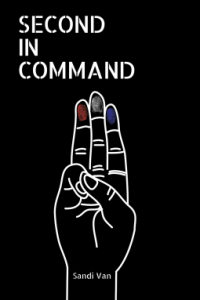
Today is the day. Second in Command is officially in the world! I am excited — and slightly terrified — but mostly excited for friends and family to be able to read something I wrote, to be able to hold a book in their hands and say, hey, I know the chic who wrote this!

cover

The journey to this moment isn’t exactly as I’d planned, but whatever is, right? I was working on an blog interview earlier this week and reflecting on my wandering path as a writer. It’s definitely been in my blood since forever. I used to make up songs about the weird wallpaper in my parents’ bathroom, and there are an usually weird number of notebooks in our house that contain my random thoughts scrawled on the pages. I write. It’s what I do. Whether or not it’s any good has always remained a mystery. I never successfully wooed anyone with my poetry, but there was that time I wrote a haiku as a model for my seventh grade students entering into a local newspaper contest and ended up with the winning entry. I’ve accumulated my share of rejections from the industry, but as my husband is fond of saying, it only takes one yes in a pile of no’s.

The first novel I wrote wasn’t very good. I know that now. At the time I thought it was genius, having never been able to write an entire novel before that moment. I wanted EVERYONE to read it. I should have kept it to myself, neatly bound and stuffed into a dresser drawer. But I didn’t and had to endure a painful amount of criticism, most of which was rightly deserved. My second novel was better, but it just couldn’t deliver all that I’d hoped it would, and it too suffered criticism and rejection. (Note: I haven’t given up on her just yet, but she needs to age a bit, like a fine wine, until I figure out how to sort out the difficulties.) While I was in the painful throes of revisions with #2, an opportunity came my way. One of the members of my critique group is an editor and she was starting a new imprint aimed at reluctant readers. She wanted young adult books written in verse. Pitch your ideas to me, she said. Hmm, I thought. I could do that. She had a list of possible topics and one of them was a parent on deployment.

My mind went immediately to 2003. We lived in Silverdale, Washington, on an incredibly steep dead end street full of military families. My husband left in January for a three week underway and didn’t come home until late September. Our next door neighbors were a sweet family with three young kids. Mom served on a deployed hospital ship. Dad worked in Seattle, which from where we lived took over an hour to get to. I remember checking up on the kids once in a while and helping them with the yard work. (We each had about .08 acres of land. Seriously. You could have cut the front lawn with a pair of clippers.) Sometimes they had me over for dinner, and once I went to a school meeting for the middle son. There’s an unwritten agreement among military families: we look out for one another.

I wanted to tell a story about a family struggling through deployment, and I wanted it to be universal so that someone who has never experienced deployment could understand what the characters felt. Separation is hard. On everyone involved. And we all handle it differently. What if one character wanted to be strong on the surface even though he was hurting on the inside? What if another character was angry and needed to act out his feelings, even if it meant getting in trouble? I wrote a poem about two brothers who promise to look out for each other. Sketched it out in the back of one of my notebooks and then read it out loud to my writing group. They loved it, so I kept going. I asked my kids to help me with character names and worked on the pitch.

My idea was accepted, and from there I had deadlines, something I have discovered is very helpful in the writing world. Left to my own devices, I’ll write when the muse strikes, but give me a calendar with something due and I’ll sit at my laptop like it’s my job. Because it was, in a way. This was the first time I got paid to write.

So here we are, a year after turning in the initial draft, a copy of my book sitting next to me on the desk like no big deal. Only it is a big deal. My kids actually read it. A book I wrote. With my picture in the back. Youngest seemed most excited about that part and wanted to know if I realized all the stuff written in my bio. (I wish I had video taped him incredulously saying, “What? Featured in Adoptive Families magazine?!?”) Oldest, who disagrees with everything I say/do/recommend said it was, “Pretty good.” My parents haven’t read it yet, but they are flying from Florida into the icy winter grips of Buffalo to attend my launch party. And my late grandmother has been sending me signs all month. She’s proud, I think.

So yeah, I’m pretty excited about today. And I hope people like the book. But if they don’t, that’s okay. Poetry isn’t for everyone. But I hope it lands in the hands of a kid, or a spouse, or someone that feels the loneliness that comes when someone you love is far away — possibly in danger, and you are doing everything you can to keep it together for your siblings, or your kids, or maybe just yourself as I had been back in 2003. I hope that person reads my words and feels a little stronger. A little less alone.

If you’d like to read the book, or send a copy to someone who might need it, visit one of these links: Amazon * IndieBound * Barnes & Noble

Happy book birthday, Second in Command!!

Mixtapes in the modern age

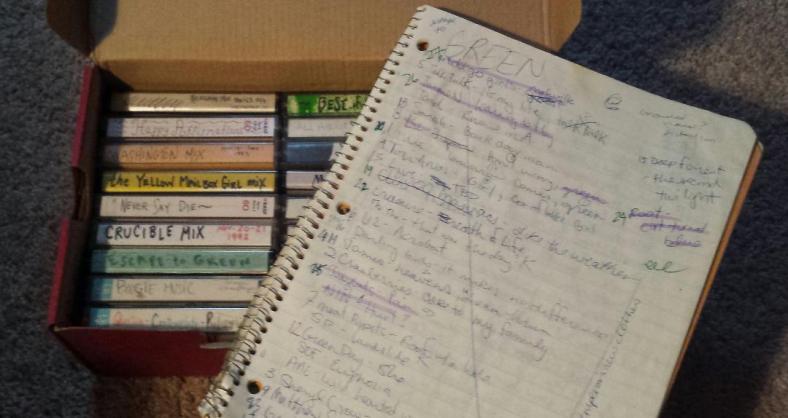
Back in the 90’s I was the queen of mixtapes*. If you were someone I cared about, you had a personalized mixtape, complete with decorated cover. I had have a notebook where I kept track of the songs on each tape. Yes, I still have the notebook. And a box full of mixes I made for myself. Just in case, ya know, tapes make a comeback. Or I figure out how to time travel.

mixes

file under: stuff I should get rid of but can’t seem to bear the thought of never seeing again

Life is different now. You want to hear a particular song? No problem. Exercise while listening to a specific style of music? No problem. Make your own virtual playlist? No problem. Gone are the days of hours spent waiting to hit record when your favorite song plays on the radio and getting stuck with the DJ’s voice on the opening chords. Not that I don’t love my mixtape titled, ALTERNATIVE ’92, which contains authentic Toronto DJ intros from the era.

There are endless playlists out there and I can listen to any song I want whenever I want (except of course when I’m stuck at soccer practice with no signal and forced to play only what is downloaded onto my laptop or listen to whatever ear worm lodged itself in my brain during the car ride). BUT. There are also endless choices. And that makes me feel a bit like when you stand in the grocery store aisle and have to decide between eight different kinds of coconut oil.

Back in the day of my mixtape notebook, I had a limited collection of CDs. I knew all of the songs — knew their lyrics, knew roughly how long they were (as one was limited to 60, 90, or 100 minutes per tape). I knew artists names. My CD’s were alphabetized, and still are, because of course I also have two giant binders full of CD’s I never listen to. I’ll spare you the photo evidence.

Now? I google the lyric to a song that’s stuck in my head and think, that’s who sings it? Or I see band names on the library playlist site and have no idea who they are or what they sing, but then I click on them and oh yeah, I actually do recognize their songs. Normally, this is no big deal. Listen to what makes you happy, I say. Pick the playlist to fit your mood.

Except. The marketing team who will help promote my book asked the authors to create a playlist. Songs that inspired us while we wrote or that might fit the mood of the story/character. Cool, I think. I definitely use music to help me write. It keeps me focused. It drowns out the noise of hockey pucks slamming into the board mere feet from my head (no one said writing at a sports arena would be easy). It helps me write emotional scenes. When I wrote the climax of my first novel, I played “Say Something” on repeat. The Smith’s “Asleep” provided the perfect mood while delivering devastating news to one of my characters in book two. So what did I listen to when I wrote Second in Command? Would it be worthy of a publicized playlist?

Let’s search the downloads from my laptop, which looped continuously as I wrote during soccer practices last year. A few Calvin Harris songs and various other electronica faves. Some Lord Huron. A whole lot of Sia. (Her lyrics are highly motivating. I love “The Greatest”.) Random stuff. Music I knew I could play in the background that had enough beat and rhythm to keep my fingers moving. Did it fit the mood of my story? Not usually. Would it be the same thing my main character would listen to? Doubtful. I asked my 12-year-old son to help make the playlist, and his suggestions did not exactly align with my taste. Hubs said, No 80’s music. Sad face. I know, I know. Surprisingly, there isn’t much of that on my computer. That’s what time traveling mixtapes are for, people.

So I turn to the Internet of Endless Choices. And I’m overwhelmed. My list, started on a small scrap of paper, has scribbles and rewrites. I decide, then un-decide. I text my sister, the person responsible for first introducing me to music and the joy of collecting one’s favorite songs. I visit the library music page. Who are these artists? I feel old.

There are some blank pages at the end of my mixes notebook; perhaps I should try that. Maybe I can unlock the hidden playlist muse or something. Or I could stop procrastinating with this blog post, and as my husband said yesterday, “Just pick the songs and be done with it.”

Stay tuned. I’ll link the playlist on my website once it’s live.

*the blog keeps telling me I’ve spelled “mixtape” incorrectly, but I googled it, and its’ a legitimate word that originated in the 70’s.