Why I simultaneously love and fear small creatures

I love nature and animals and have been known to carry on many a one-sided conversation with the creatures who visit our backyard. But if they try to come into the house, I freak out. And if they end up dead anywhere on the property, I freak out even harder. Which occasionally happens out here in the suburbs and which inspired me to write a piece called “Carcass”. I entered “Carcass” into the Pennwriters In Other Words contest, an annual contest with three different categories: non-fiction, fiction, and poetry. Pieces must fit on one single sheet of paper and are posted on the wall for participants to vote on during the conference. My first year in attendance (2015), I took third place in both the fiction and poetry categories but haven’t had success since then.

Until this year. My friend/traveling companion and I both entered, and we wanted to stick around for the results but decided to leave early so that we could be back with our families by dinnertime. We asked the coordinator if we won. She looked at our name tags and shook her head. Disappointed but still full of positive energy from the weekend, we returned home.

Later that day, someone posted on Twitter that her friends had won. I sent a message of congratulations, and she said, “heard you won one yourself”. Say what? Turns out I earned second place in the non-fiction category, and my friend won second in fiction. We were thrilled, but a little sad we missed the excitement of receiving the award. Thankfully, the coordinator contacted us and sent us our certificates in the mail.
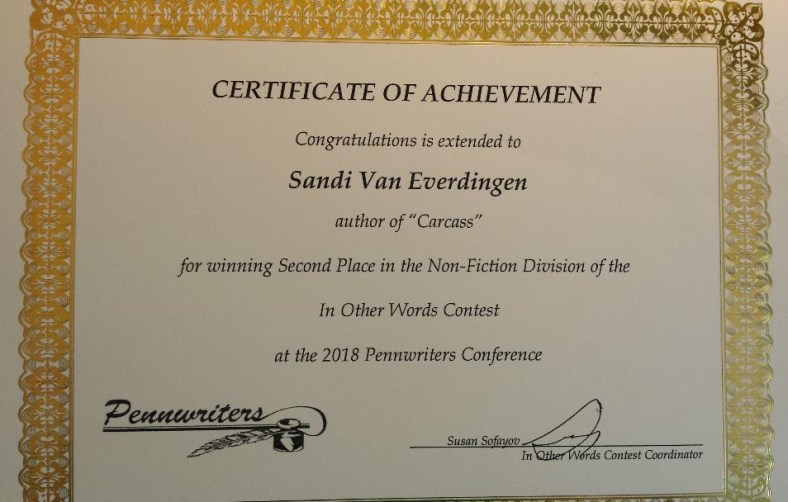
cert

I’m pleased to have placed in all three categories, and will keep writing and aiming for that first place spot!

Without further ado, here is my piece:

CARCASS

 There’s a dead mouse in the basement.

I walked down there to look in my high school memory box for my not-quite Rubix Cube because the youngest spent all afternoon trying to solve the actual Rubix Cube. I went down to the basement and there it was.

Dead.

All sad and mouse-like on the freshly vacuumed carpet. Carpet, I might add, that until last week was covered in piles of boxes, tissue paper, unwanted toys, and tons of other crap. We spent the afternoon cleaning everything out and uncovered scattered mouse poop who knows how old. My 40th birthday cards were in that pile. I turned 41 three months ago.

Now the space is clean, the rug mouse-poop free. But not mouse free. Because as soon as I saw it my heart started to pound in the way it does when I come across dead things, and I did an immediate about face. Headed back upstairs and pretended I had never gone down there in the first place.

Hubby comes home late tonight. He’ll come across the mouse. Eventually. He’ll take care of it. The question is, do I wait for him to notice it or tell him I saw it and didn’t feel it was within my realm as chief house cleaner to do anything about it? When he sees it will he clean it up without saying anything?

I think back to the last mouse, the one that squirreled away cat food in a rolled-up rug and caused Mia to pee all over the house in anger. We put out poison but never found a body. The tiny green pellets housed in innocent looking cardboard triangles remained scattered throughout the basement. Leftover poison. We killed this mouse. And it took the liberty of dying right there in the newly cleaned room.

Sadness weighs on me, like steel.

Is it sadness I feel, or something else? And why do dead animals bring trauma to my soul? I remember the suicidal crow that landed in our back porch back in Corning. Hubby was away; I had to carry it into the woods by myself. Scooped up its body with a shovel and carried it back there on our rickety wheel barrow. When I think back to that day I can still feel my pounding heart.

And the bees I found when I unscrewed the switch plate in my parent’s living room. Oh Lord the bees. Vacuuming them out from across the room after a panic attack that lasted much longer than one should panic over a pile of dead, harmless bees.

I think there might be something wrong with me.
Different kinds of smart

Oh, technology. I want to embrace you, but sometimes you frustrate me so.

Today’s mission: forward progress on the whole marketing thing. Let’s start with updating the blog. Link all of my accounts together. Easy-peasy.

Or not.

There may have been some yelling and shaking of fists. Possibly a curse word or two. I think the problem with all of this is I do not consider myself tech-savvy, despite the fact that I am often the go-to person at work for such things, and I am most definitely not a visual person. Which you may have guessed from the lack of photos and other visual elements on my blog.

Remember back in the day when Gardner’s multiple intelligences was a thing? His theory is that there are seven (and eventually nine when he added naturalistic and existential) types of learners, and we all fall in one or more categories. We are all different kinds of smart. He was at the height of educational popularity during my time as an undergrad, and I did a whole bulletin board lesson complete with student self-assessments and tips on how to maximize your learning style. So of course I took the self-assessment and -SHOCK- came out a logical/linguistic learner with musical undertones. Translation: I’m good at reading and math, and can parody just about any song. My lowest scores were in spatial and interpersonal. Translation: I can’t read a map or interact normally with others.

Here I am, faced with the challenge to create something visually appealing that will encourage people to support me as an author.

You can see why I feel a tad uncomfortable. Give me a book or a math problem and I will read/analyze/solve it. When I need to memorize information, I set it to music or create word-links. Ask me to navigate out of a parking lot downtown and successfully find my way back home? Not even with the lady in my phone telling me which way to go. (Side note, this is why I hate when my dad gives directions and asks me to “picture it”.) Put me in a party setting and expect me to make clever conversation? Maybe after a drink. Just one. Two drinks and I’m challenging my husband’s co-worker to a push-up contest. True story.

So how do we work through something that involves our weaker intelligences? You don’t need to subscribe to Gardner’s theory to know that there are things you do well, and things that make you want to shake your fist angrily. Focus on what you do well. Use that to the fullest, and then call in reinforcements. I have friends that are amazing at website development and making things visually appealing. These friends will be hearing from me. Don’t be afraid to make mistakes. And most importantly, don’t give up. I eventually figured out how to link my other sites and update the blog widgets. I even joined Instagram, despite my fear of its visual focus.

We can’t change our fundamental makeup–I frequently clam up and/or embarrass myself in public no matter how hard I try not to–but we can embrace who we are and figure out how to work through our challenges. That being said, I WILL have my website up and running by the end of the month. And I’d love feedback/suggestions on the new blog design (updated cover photo coming soon).


Spring book report

What’s that they say about best laid plans? I set out to do monthly book reports, which became bimonthly (I totally just googled this term to double check, and it does in fact mean “twice a month or every other month” because that’s not confusing at all), which has now become seasonal. Because soccer.

Yup, that’s my excuse for everything these days. Soccer takes up EVERY. SINGLE. DAY. We ate dinner as a family Monday night and my children forgot where to sit. THEY FORGOT WHERE TO SIT.

I digress. This post is about books. I like to read them. I haven’t read very many in the past few months and therefore could not share my favorites as often with you, fine blog followers. But here are a few I’ve enjoyed since my last book post. Coincidentally perhaps, these books would make excellent summer reads for young and old alike!

The War That Saved My Life by Kimberly Brubaker Bradley
Our elementary school librarian recommended this book to me, and I listened to the audio version. Like any war story, it has its share of heartbreak, but I loved the innocence of the main character and how she grew to love and trust the people who cared about her. It is more about her journey to acceptance than the war, but the setting provides a powerful backdrop.

Science Fair by Dave Barry and Ridley Pearson
Speaking of audio books, this one is hysterical. And so corny. But sometimes we need that in our life, right? A great road trip book – 8 and 12 year old boy approved.

Soldier’s Heart by Gary Paulsen
I taught this book to 7th graders and believe every middle schooler should read it. It tells the story of a young boy who lies about his age to fight in the Civil War. It is a quick read and one that is best done out loud if possible – I enjoyed reading it to my classes, and recently read it to my oldest son. We both ❤ Gary Paulsen, and you should too. Hatchet was on oldest’s mom-required summer reading list last year. He loved it.

Flying Leap by Judy Budnitz
If you are looking for a book you can read in bursts – say at the pool/beach/soccer field – then this is a good pick. It is a collection of short stories that is slightly odd and is sure to give you a furrowed brow that will prevent people from interrupting you while you read at the pool/beach/soccer field. I recommend it to fans of Shirley Jackson and Roald Dahl (his short stories, not his children’s books) because of the dark, off-kilter themes.

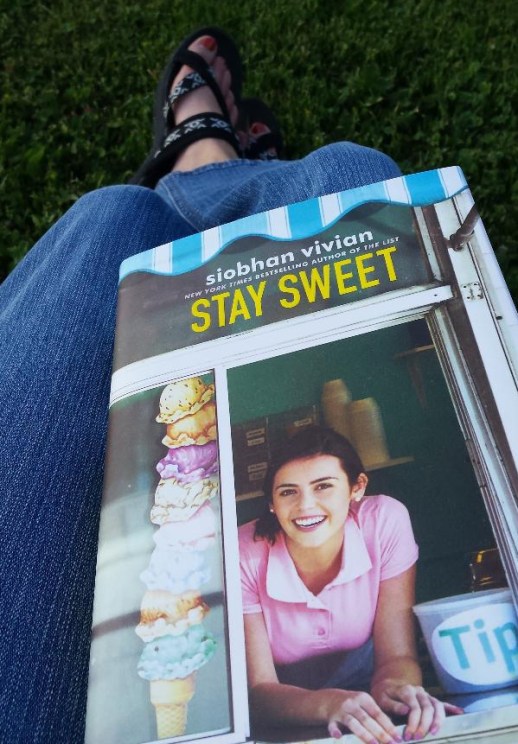
What’s on the nightstands right now? you ask. Oldest and I are reading Postcards from Venice, the newest release from the lovely and talented Dee Romito, youngest and I are reading the final book in the American Epochs series, Time to Heal by Todd McClimans, and I just started Stay Sweet by Siobahn Vivian, recommended to me by an editor at the Pennwriters conference. Feels like the perfect pool/beach (sigh… who am I kidding – soccer field) read.

book

Week four of camp: What really counts

My stats for Camp NaNoWriMo are embarrassing. However, I am proud of the fact that I blogged every week, which is a goal I set for myself in late March. And while writing often slips down to the bottom of my to-do list, it has not fallen off completely, even if my desk is a mess of all things not related to writing, and I spend far to much time wandering around my house completely overwhelmed by the stuff that seems to multiple while I sleep.

Data is great. It helps with identifying a problem and measuring the success of implemented strategies (wow, I totally sounded like an administrator right there). Data can also make you feel worthless, like when I look at my project statistics and the bulls-eye that barely made it through the second outer ring.

I taught special education in middle school for four years. During my second year, our building was in danger of a massive restructuring and forced to focus a ridiculous amount of time and energy on improving test scores. My small group of students were reading below grade level. Way below grade level. To go from a 1 to a 3 (out of 4) on their state tests was not reasonable despite the desperate pleas of my administration, and I struggled to find ways to help them feel successful. In the weeks leading up to the tests, I set individual, attainable goals for each student, worked on skills that would help them do better — and here’s the most important part — taught them how to be calm and confident during a testing situation. Not focus on what they couldn’t accomplish, but rather what they could. I’m happy to say that many of my students improved on their previous scores, and we celebrated the success — even though their scores were still below the “acceptable” level.

I am a bit ashamed by the lack of overall progress during camp but happy to say that my percentage accomplished went from 27.6% in July to 36.9% in April. An improvement. And while my final day of working on the camp project was spent deleting more words than adding new ones, I decided that what really counts is forward momentum. Not giving up. I will continue to write, continue to work on my WIP, continue to participate in the monthly writing challenges.

What really counts is attitude. Confidence. Belief in yourself no matter the obstacle. My students were told they were the lowest performers in the school, but they refused to let a number dictate what they were capable of accomplishing. In my current job, I see adults return to school after years of working, raising a family, overcoming illness — they sit in my office and tell me they are finally ready to earn their degree and will do whatever it takes.

What really counts is determination.